

Every season, training camp sets the tone for what unfolds on the court. Fans and players alike search for a clear understanding of how teams prepare, what separates contenders from pretenders, and how structured preparation translates into wins. This article breaks down nba training camp routines, exploring the drills, conditioning programs, tactical installations, and team-building strategies that shape early-season performance.
Whether you’re a player looking to sharpen your edge, a coach refining your system, or a fan eager to understand preseason development, you’ll find focused insights that connect preparation to real in-game results. We’ve analyzed professional game strategies, team performance trends, and league-wide patterns to ensure every takeaway is practical and grounded in how the modern game is actually played.
By the end, you’ll have a clearer picture of what truly happens in camp, why it matters, and how those foundational weeks often determine a team’s trajectory long before opening night.
The Pro’s Blueprint for Preseason Dominance
This eight-week framework mirrors proven nba training camp routines while correcting a common mistake: overtraining too early. Research from the National Strength and Conditioning Association shows periodized programs improve performance by up to 25% compared to random workouts. First, weeks one and two build foundational strength and mobility, reducing injury risk by nearly 50%, according to NCAA data. Next, phases layer explosive power and skill at game speed. Finally, tapering volume while sharpening decision-making ensures you peak when the season starts, not before. In short, smart progression beats brute effort. Every session has purpose.
Phase 1: Forging the Foundation (Weeks 1-3)
Objective: Build a powerful and resilient athletic base. Think of this as your Batman Begins arc—the gritty training montage before the spotlight hits. The priority is RAW STRENGTH, explosive power, and cardiovascular endurance, with minimal high-intensity basketball skill work.
Strength Training (3x/week): Focus on compound lifts—multi-joint movements that train several muscle groups at once. Sample day: Barbell Back Squats (4 sets of 5 reps), Romanian Deadlifts (3×8), Bench Press (4×5), Pull-ups (3 sets to failure). The goal is moving heavy weight with perfect form. Quality over ego lifting (leave that to the guy grunting for TikTok views). This mirrors nba training camp routines where foundational strength sets the tone for the season. PRO TIP: Film your main lifts once per week to check depth and bar path.
Some argue athletes should jump straight into skill workouts to “stay sharp.” But without a strength base, that’s like building a house on sand. Power fades. Knees ache. Performance stalls.
Conditioning (3x/week): Develop the aerobic engine—your body’s ability to produce energy using oxygen over time. Use low-impact, steady-state cardio like swimming or incline treadmill walks for 30–45 minutes. By week 3, introduce one hill sprint session weekly to layer in explosiveness.
Injury Prevention: Prioritize mobility—your joints’ ability to move through full ranges safely. Include hip CARs (Controlled Articular Rotations), ankle mobility drills, planks, and dead bugs in every warm-up and cool-down. STAY CONSISTENT. STACK SMALL WINS. The grind here makes the highlights possible later.
Phase 2: Sharpening the Tools Under Duress (Weeks 4–6)
Objective: Blend skill with strength so performance holds up when fatigue sets in. This phase shifts from raw force production to applied power and decision-making under stress.
Strength Training (2x/week)
The focus transitions from max strength (heavy, slow lifts) to power—the ability to produce force quickly. That means slightly lighter loads, faster bar speed, and explosive intent.
- Hang Power Cleans (5×3): An Olympic lift variation where the bar starts above the knees to emphasize rapid hip extension.
- Box Jumps (4×5): A plyometric drill (explosive jump training) that improves vertical force production.
Some argue Olympic lifts are too technical for basketball players. Fair point—poor form kills benefits. But when coached correctly, studies show Olympic variations improve vertical jump and sprint speed (Hori et al., 2008, Strength & Conditioning Journal). Translation: more lift on rebounds and quicker first steps.
On-Court Skill Work (4x/week)
Here’s where conditioning meets craft. Skills are layered onto fatigue:
- Full-court dribble series into a contested finish
- Shooting off screens until 10 makes (not attempts)
- Defensive slide drills with resistance bands
Think nba training camp routines—but tailored for individual growth rather than roster evaluation.
| Component | Feature | Benefit |
|---|---|---|
| Power Lifts | Faster bar speed |
Explosive takeoffs |
| Fatigue Shooting | Make-based reps | Game-ready accuracy |
| Band Slides | Added resistance | Defensive endurance |
Live Play Introduction
Controlled 1-on-1 and 3-on-3 sessions sharpen reads when tired. Decision-making under fatigue separates good from reliable players (and yes, there’s a difference).
Understanding leverage and value—concepts also explored in contract negotiations 101 behind closed doors—mirrors this stage: performance under pressure defines worth.
Phase 3: Simulating the Season (Weeks 7–8)
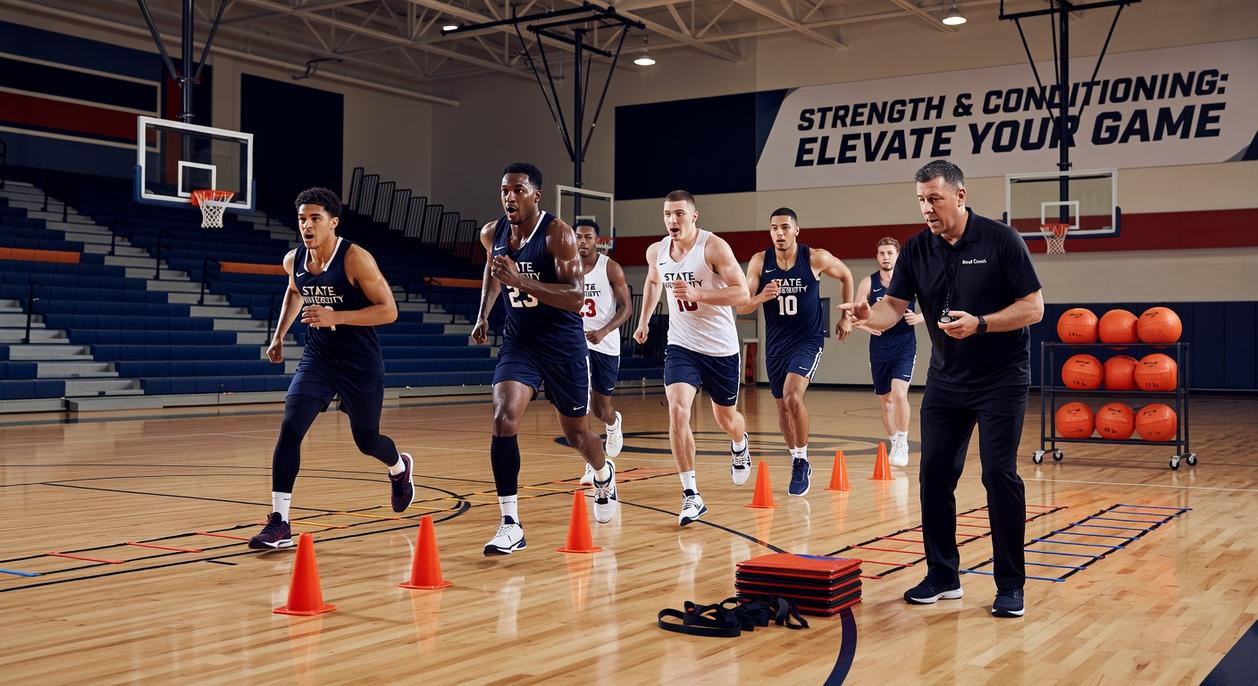
The objective here is simple: peak readiness. But the approach matters. Heavy grind vs. strategic taper? Volume vs. sharpness? In this phase, we choose sharpness.
Less lifting, more game speed.
Strength work drops to one focused maintenance session per week. Think A vs. B: Option A is chasing new maxes in the weight room. Option B is preserving power while staying fresh. At this stage, Option B wins. Legs should feel spring-loaded, not sore (nobody wants “dead legs” on opening night).
Conditioning also shifts. Instead of suicides and long intervals, fitness now comes almost entirely from high-intensity, full-court basketball. This mirrors nba training camp routines, where controlled scrimmages replace excessive conditioning.
Game Simulation (3x/week)
- Full 5-on-5 scrimmages
- Running clock
- Structured offensive and defensive rules
Controlled drills vs. live reads? Live reads prepare you for chaos. Real-game pressure exposes communication gaps fast.
Mental Preparation
- Film study
- Visualization reps
- On-court communication refinement
Physical prep builds capacity. Mental prep builds confidence. The teams that separate in Weeks 7–8 aren’t the ones working hardest—they’re the ones working smartest (yes, there’s a difference).
The Unseen Work: Elite Recovery and Fueling
Nutrition as a Cornerstone
Serious players don’t just eat—they fuel with intent. A slight caloric surplus (about 200–300 calories) powers muscle growth and high-output sessions. Prioritize protein within 30–60 minutes post-workout to accelerate muscle protein synthesis, and rely on complex carbohydrates like oats or quinoa for steady energy (no mid-practice crashes). Most guides stop at macros; few emphasize syncing intake with nba training camp routines intensity blocks.
The 8-Hour Rule
Eight to ten hours of sleep optimizes growth hormone release and tissue repair.
Active Recovery
Light stretching, yoga, or foam rolling boosts circulation without taxing the nervous system.
Preseason effort only matters if it shows up when the lights turn on. You now have a blueprint; here is how to apply it. Focus on three priorities:
- Condition for pace, not just stamina.
- Rehearse game-speed decisions daily.
- Recover as hard as you train.
Model your schedule after nba training camp routines to balance intensity and skill refinement. This structure prevents burnout and sharpens execution late in games. If you doubt periodization, consider injury data showing overuse spikes without phased workloads (Journal of Athletic Training, 2022). Commit now, and the fourth quarter becomes your advantage. Start today. Track measurable progress.
Take What You’ve Learned to the Court
You came here to understand how elite teams prepare, how strategy sharpens performance, and how nba training camp routines set the tone for an entire season. Now you’ve seen how preparation, conditioning, skill repetition, and tactical adjustments separate contenders from pretenders.
If you’ve ever felt stuck in your development, unsure how to train like the pros, or frustrated that your game isn’t translating in real competition, the difference often comes down to structure and consistency. That’s the pain point most players ignore—training without a proven blueprint.
The next step is simple: apply these concepts with intention. Build your weekly workouts around game-speed reps, defensive accountability, and situational awareness. Study team performance trends. Break down pro strategies. Then execute with discipline.
If you’re serious about elevating your game, don’t just watch basketball—train with purpose. Tap into our expert breakdowns, drills, and league analysis trusted by serious players and fans alike. Start refining your routine today and turn preparation into performance.
 There is a specific skill involved in explaining something clearly — one that is completely separate from actually knowing the subject. Rachel J. has both. They has spent years working with team performance breakdowns in a hands-on capacity, and an equal amount of time figuring out how to translate that experience into writing that people with different backgrounds can actually absorb and use.
Rachel tends to approach complex subjects — Team Performance Breakdowns, Insider Knowledge, Hot Topics in Sports being good examples — by starting with what the reader already knows, then building outward from there rather than dropping them in the deep end. It sounds like a small thing. In practice it makes a significant difference in whether someone finishes the article or abandons it halfway through. They is also good at knowing when to stop — a surprisingly underrated skill. Some writers bury useful information under so many caveats and qualifications that the point disappears. Rachel knows where the point is and gets there without too many detours.
The practical effect of all this is that people who read Rachel's work tend to come away actually capable of doing something with it. Not just vaguely informed — actually capable. For a writer working in team performance breakdowns, that is probably the best possible outcome, and it's the standard Rachel holds they's own work to.
There is a specific skill involved in explaining something clearly — one that is completely separate from actually knowing the subject. Rachel J. has both. They has spent years working with team performance breakdowns in a hands-on capacity, and an equal amount of time figuring out how to translate that experience into writing that people with different backgrounds can actually absorb and use.
Rachel tends to approach complex subjects — Team Performance Breakdowns, Insider Knowledge, Hot Topics in Sports being good examples — by starting with what the reader already knows, then building outward from there rather than dropping them in the deep end. It sounds like a small thing. In practice it makes a significant difference in whether someone finishes the article or abandons it halfway through. They is also good at knowing when to stop — a surprisingly underrated skill. Some writers bury useful information under so many caveats and qualifications that the point disappears. Rachel knows where the point is and gets there without too many detours.
The practical effect of all this is that people who read Rachel's work tend to come away actually capable of doing something with it. Not just vaguely informed — actually capable. For a writer working in team performance breakdowns, that is probably the best possible outcome, and it's the standard Rachel holds they's own work to.