

If you’re looking to improve your performance on the court, it starts with mastering the details that separate consistent scorers from streaky shooters. This article is built for players, coaches, and fans who want clear, practical insight into shooting form fundamentals and how they directly impact game results. From foot placement and balance to release mechanics and follow-through, we break down the core techniques that translate into higher shooting percentages under real-game pressure.
Rather than recycling generic tips, this guide draws on proven pro-level strategies, in-depth game analysis, and performance breakdowns across competitive leagues. We connect technical form adjustments to actual in-game scenarios—so you understand not just what to fix, but why it matters.
Whether you’re refining your mechanics, coaching a developing player, or analyzing team scoring efficiency, this article gives you focused, actionable insights designed to elevate consistency, confidence, and overall offensive impact.
Building your shot starts at the floor. Inconsistent shooting usually comes from a broken kinetic chain, where weak footwork throws off balance, timing, and release. Fix the base first.
• STANCE
• BALANCE
• FOLLOW-THROUGH
These are the shooting form fundamentals that create repeatable motion. Think of it like stacking Jenga blocks (pull one wrong piece and everything wobbles).
Some argue great shooters are just born with touch. But film study shows mechanics drive percentages.
SPECULATION: As training tech advances, future players will rebuild mechanics from the ground up, prioritizing footwork sensors and data feedback.
PRO TIP: Start every drill with feet set.
The Foundation: Why Every Great Shot Starts with Your Feet
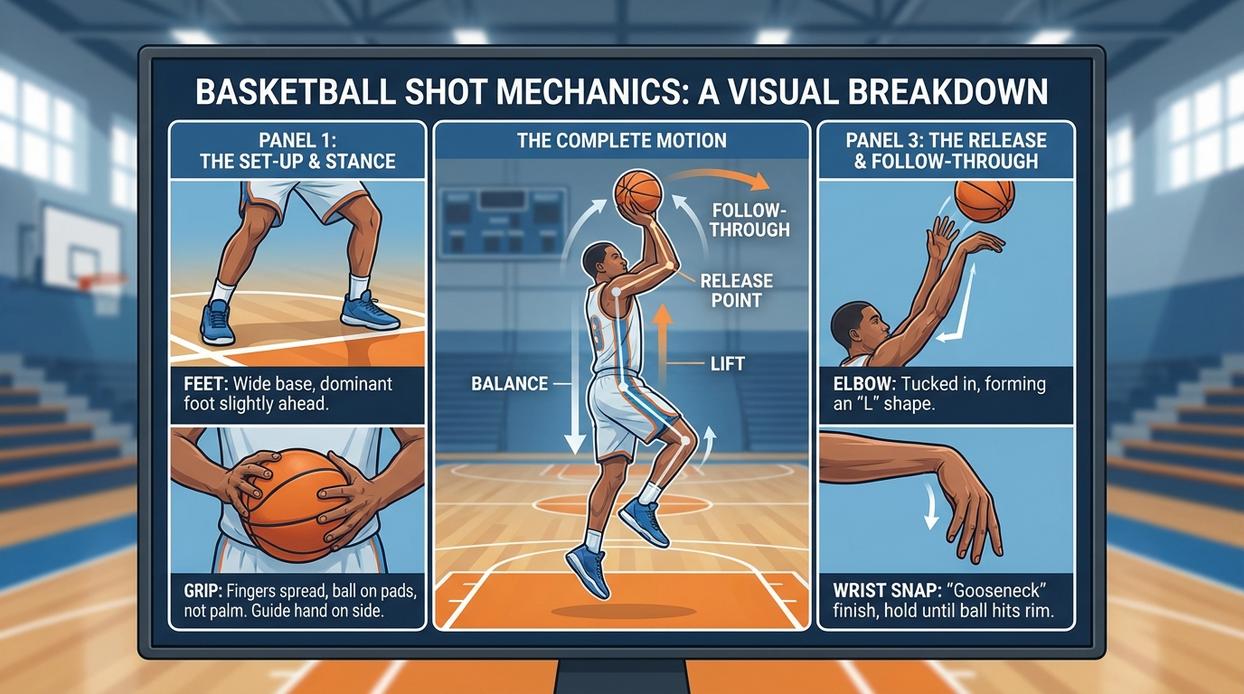
If you want a consistent jumper, start from the ground up. Stance and alignment mean pointing your feet toward the basket, about shoulder-width apart, so energy travels in a straight line. Think of it like lining up a golf putt—misaligned feet force midair adjustments (and that’s when bricks happen).
Some players argue that great shooters can score off-balance, so foot placement is overrated. Watch the film closely. Even elite shot-makers reset their base before release. Balance isn’t optional; it’s repeatable physics. According to biomechanical research on jump performance, force generated from the lower body significantly increases shooting range and stability (Knudson, 2007).
Balance is power. The “dip” — a controlled lowering of the hips before rising — loads your legs like springs. The upward motion should feel fluid, not rushed. Arms guide; legs drive. That’s shooting form fundamentals.
Then comes the One-Two Step: catch on one foot, plant the other, rise immediately. It’s efficient, quick, and hard to contest (Steph Curry makes it look automatic, but it’s trained repetition).
Drill: Foundation Holds. Drop into your stance and hold for 30 seconds. Build stability without even taking a shot. Pro tip: keep your heels light but grounded for optimal balance.
Upper Body Mechanics: Mastering the Shot Pocket and Release
The Shot Pocket
The shot pocket is the space between your chest and chin where the ball pauses before launch. In my opinion, this is where great shooters separate themselves. Start too low and your release gets slow (hello, blocked shots). Start too high and your motion feels robotic. Think of Klay Thompson—compact, efficient, repeatable. That’s the gold standard. A consistent shot pocket builds rhythm and speed, two pillars of shooting form fundamentals.
Grip and Hand Placement
Hold the ball with relaxed fingers, not a death grip. Tension is the silent killer of touch. Spread your fingers comfortably so the ball rests on your fingertips, not your palm. The guide hand? It’s there for balance, not force. If your guide hand is pushing, your shot will drift sideways (and you’ll blame the rim). I always tell players: if your off-hand thumb is influencing the ball, fix it now.
Elbow Alignment
The “L” shape rule matters. Your shooting arm should form roughly a 90-degree angle, with the elbow directly under the ball. Some argue unique forms can still work—and sure, exceptions exist. But for most players, elbow alignment is non-negotiable for accuracy. Physics backs this up: straighter force lines mean fewer directional errors (Knudson, Biomechanics of Basketball Shooting, 1993).
Eyes on the Target
Pick a specific target—front rim or back rim—and lock in. Research shows focused visual attention improves motor accuracy (Vickers, 1996). Don’t let your eyes drift mid-shot. Discipline here pairs perfectly with defensive footwork drills for quick lateral movement: https://sffarebasketball.net/defensive-footwork-drills-for-quick-lateral-movement/.
Pro tip: hold your gaze and your follow-through until the ball hits the rim. It trains consistency (and confidence).
Creating backspin is not magic; it is physics. When your wrist “snaps” at release, your fingers roll over the ball, generating reverse rotation. That rotation—called backspin, meaning the ball spins backward toward you—slows the ball when it contacts the rim, producing softer bounces and friendlier rolls. In other words, the rim becomes a cushion instead of a trampoline (and we all prefer kind rims). The coaching cue “in the cookie jar” captures this perfectly: imagine reaching high into a jar above your head, elbow up, wrist relaxed, fingers down.
However, the motion is only half the story. Hold your form until the ball hits the rim. This pause acts as built-in feedback. If your elbow flares or your guide hand interferes, you will feel it immediately. Over time, this reinforces shooting form fundamentals without overthinking mechanics.
To sharpen the finish, use the Form Shooting drill. Stand directly in front of the basket and take one-handed shots, focusing exclusively on wrist snap and a high follow-through. Start five feet away, make ten perfect swishes before stepping back. Pro tip: track makes versus “clean” makes—shots that never touch the rim—to measure true consistency.
Discipline today becomes confidence tomorrow under pressure in games.
Common Mistakes and How to Correct Them
Even solid shooters drift into bad habits. Here’s how to spot—and fix—the big four.
-
The Thumb Flick
Your guide hand should stabilize, not steer. If the ball spins sideways, your thumb is likely pushing it offline. Film your release and check for off-center rotation. Fix it by shooting one-handed form shots near the rim (yes, it feels elementary, but it works). -
Flat Arc vs. High Arc
A flat shot reduces margin for error. Research shows higher arcs improve make percentages (Noah Basketball, 2023). Add arc by finishing with a higher follow-through and relaxed wrist. Think “rainbow,” not “laser.” -
Rushing the Shot
Speed kills rhythm. Build tempo into your shooting form fundamentals so your dip, rise, and release flow together. Under pressure, smooth beats fast (Steph Curry makes it look rushed—it’s not). -
The Catapult Shot
Bringing the ball behind your head slows release and hurts accuracy. Keep it tight to your shooting pocket.
Prediction: As defenses get longer and quicker, compact mechanics will become non-negotiable.
From Technique to Instinct: Your Path Forward
You now have a complete blueprint for a mechanically sound, repeatable shot. If you feel inconsistent, understand this: inconsistency is usually mechanics, not luck. When coaches talk about shooting form fundamentals, they mean the building blocks—stance, balance, alignment, release—that stack from the feet up.
Break it down simply:
- BALANCE first.
- ALIGNMENT next.
- FOLLOW-THROUGH last.
Master each piece through Form Shooting drills. Focus on one principle at a time until it feels automatic (like muscle memory in a video game boss fight). Pro tip: film reps and review in slow motion.
Take Control of Your Shot and Elevate Your Game
You came here to improve your consistency, confidence, and scoring ability on the court—and now you have a clear roadmap to do exactly that. By focusing on shooting form fundamentals, refining your mechanics, and understanding how small adjustments impact accuracy, you’re no longer guessing why your shots miss. You’re building a repeatable, reliable stroke.
Every missed shot can feel frustrating, especially when you’re putting in the work but not seeing results. That’s the pain point most players face—effort without efficiency. The difference-maker is mastering the details and training with purpose.
Now it’s time to act. Start applying these drills in your next workout, track your progress, and commit to tightening your form every single session. If you’re serious about becoming a more complete scorer, explore our in-depth breakdowns, pro-level strategies, and performance insights trusted by dedicated players who want real results.
Don’t settle for streaky shooting. Lock in your fundamentals, train smarter, and take the next step toward becoming the most reliable shooter on the floor.
 Jeff L. has opinions about team performance breakdowns. Informed ones, backed by real experience — but opinions nonetheless, and they doesn't try to disguise them as neutral observation. They thinks a lot of what gets written about Team Performance Breakdowns, Fare League Play Analysis, Basketball Skill-Building Drills is either too cautious to be useful or too confident to be credible, and they's work tends to sit deliberately in the space between those two failure modes.
Reading Jeff's pieces, you get the sense of someone who has thought about this stuff seriously and arrived at actual conclusions — not just collected a range of perspectives and declined to pick one. That can be uncomfortable when they lands on something you disagree with. It's also why the writing is worth engaging with. Jeff isn't interested in telling people what they want to hear. They is interested in telling them what they actually thinks, with enough reasoning behind it that you can push back if you want to. That kind of intellectual honesty is rarer than it should be.
What Jeff is best at is the moment when a familiar topic reveals something unexpected — when the conventional wisdom turns out to be slightly off, or when a small shift in framing changes everything. They finds those moments consistently, which is why they's work tends to generate real discussion rather than just passive agreement.
Jeff L. has opinions about team performance breakdowns. Informed ones, backed by real experience — but opinions nonetheless, and they doesn't try to disguise them as neutral observation. They thinks a lot of what gets written about Team Performance Breakdowns, Fare League Play Analysis, Basketball Skill-Building Drills is either too cautious to be useful or too confident to be credible, and they's work tends to sit deliberately in the space between those two failure modes.
Reading Jeff's pieces, you get the sense of someone who has thought about this stuff seriously and arrived at actual conclusions — not just collected a range of perspectives and declined to pick one. That can be uncomfortable when they lands on something you disagree with. It's also why the writing is worth engaging with. Jeff isn't interested in telling people what they want to hear. They is interested in telling them what they actually thinks, with enough reasoning behind it that you can push back if you want to. That kind of intellectual honesty is rarer than it should be.
What Jeff is best at is the moment when a familiar topic reveals something unexpected — when the conventional wisdom turns out to be slightly off, or when a small shift in framing changes everything. They finds those moments consistently, which is why they's work tends to generate real discussion rather than just passive agreement.