

Basketball is evolving faster than ever, and fans want more than just box scores and highlight reels. They want to understand why teams win, how strategies shift in real time, and what truly separates contenders from pretenders. This article breaks down the hottest topics in today’s game—from pro-level strategies and team performance trends to in-depth Fare League analysis and practical drills that translate insight into action.
We focus on the details that matter: late-game adjustments, spacing concepts, defensive schemes, and the growing influence of sports analytics departments on roster construction and in-game decision-making. By combining film study, performance data, and tactical breakdowns, this guide delivers clear, actionable insights for players, coaches, and serious fans alike.
If you’re looking to sharpen your basketball IQ, understand current trends shaping the league, and apply proven drills to elevate your game, you’re in the right place.
The New Front Office: How Data Became the MVP
Championships aren’t forged by sweat alone; they’re quietly assembled in rooms humming with servers and cold brew. In an era of peak athletic performance, intuition is the assistant coach, not the headliner. With margins razor thin, teams turn to sports analytics departments to decode shot selection, manage fatigue, and predict matchups like they’re spoiling next week’s episode. Data is the new MVP, tracking everything from defensive rotations to how often a star player forgets to box out (it happens). Skeptics argue numbers can’t measure heart, and they’re right—mostly. But when heart and hard data team up, scoreboards tend to agree.
Beyond the Box Score: What Modern Sports Analytics Departments Actually Do
A modern analytics unit isn’t a lone numbers guru with a spreadsheet. It’s a multi-disciplinary team blending statistics, computer science, and sports science to turn raw data into competitive advantage. Think less “Moneyball montage” and more mission control.
At the core, sports analytics departments focus on four pillars:
- Player evaluation and recruitment: Building predictive models that project future performance based on college stats, shot profiles, and even biomechanical markers.
- Opponent analysis: Breaking down tendencies—like pick-and-roll coverages or late-game play calls—to design targeted game plans.
- In-game strategy: Real-time win probability models guiding timeout usage, substitution patterns, and shot selection.
- Player health and load management: Monitoring GPS tracking, heart rate variability, and workload to reduce injury risk.
Traditional scouting leaned on the “eye test,” where intuition ruled. While experience still matters, data-driven systems now quantify traits like spacing gravity or defensive impact that don’t show up in box scores. According to a 2023 McKinsey report, teams using advanced analytics saw measurable gains in player efficiency and injury reduction.
The scope of data is staggering: public stats, optical tracking coordinates, wearable biometric feeds, and proprietary spatial models. The benefit? Smarter roster construction, sharper tactics, and healthier athletes—advantages that compound over an 82-game grind.
Decoding the Athlete: Using Data to Maximize Player Potential
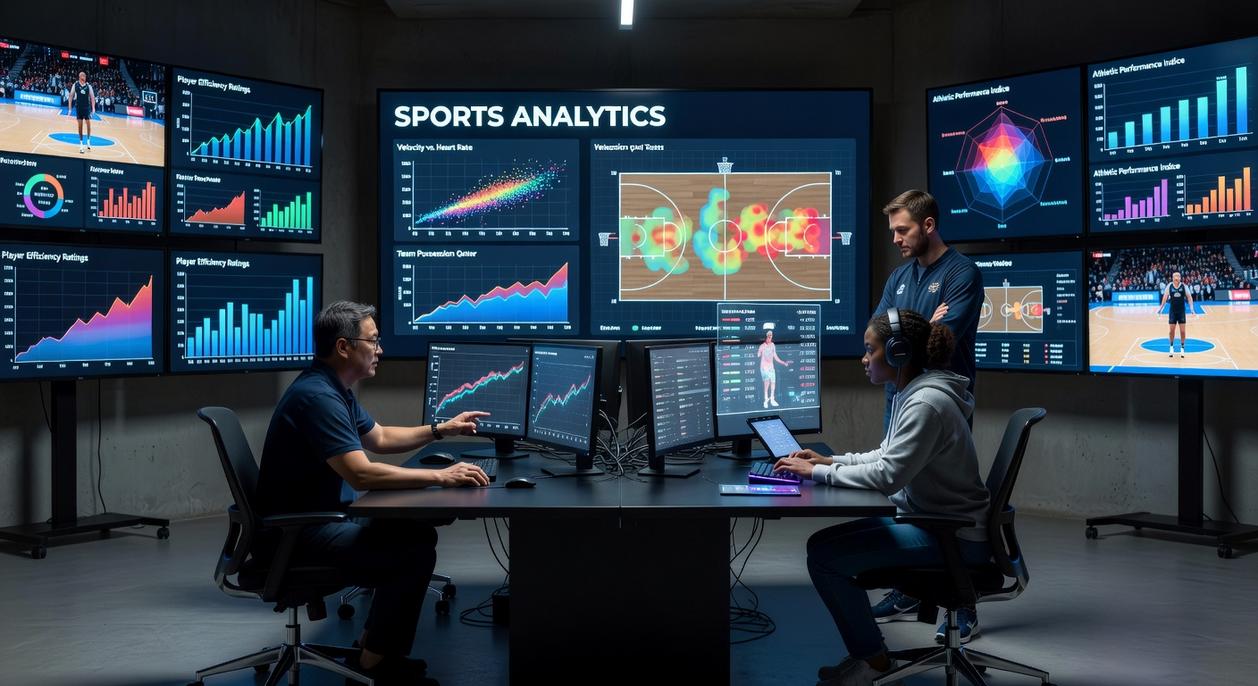
Modern performance isn’t just about hustle; it’s about measurable insight. Coaches now rely on data to clarify what used to be guesswork.
Biometric Monitoring
Wearable devices like GPS vests and heart rate monitors track player load (the total physical stress placed on an athlete), fatigue levels, and recovery rates. If a basketball guard covers four miles in high-intensity bursts during a game, that workload is logged instantly. Over time, patterns emerge. When sprint counts spike and sleep scores dip, performance often drops (and yes, the legs feel like concrete).
Injury Prevention
Injury prediction sounds futuristic, but it’s grounded in trend analysis. Analysts study variables like muscle asymmetry, sudden workload increases, and reduced joint stability. When data shows a 15% jump in weekly exertion, that’s a red flag. Proactive rest or modified drills can prevent strains before they happen. This is how sports analytics departments reduce soft-tissue injuries across long seasons.
Skill Development
Motion-capture systems and video breakdowns provide granular feedback, meaning highly detailed, frame-by-frame insights. For example:
- A shooter’s arc angle and wrist snap timing
- A defender’s lateral foot placement
- A center’s release point consistency
Small adjustments—like raising a shot arc by two degrees—can significantly improve accuracy.
Personalized Plans
All this data feeds customized training and nutrition strategies. If an athlete metabolizes carbs quickly, their fueling plan adjusts. If recovery slows after back-to-back games, workload scales down. The result? Smarter training, longer careers, and performance that’s optimized—not just maximized.
The Digital Playbook: Crafting Game-Winning Strategies with Analytics
Data has become the modern coach’s clipboard. But let’s move past basic stats and into strategy you can actually apply.
Advanced Opponent Scouting
Traditional scouting looks at tendencies—”they shoot more from the left wing.” Advanced scouting digs deeper. Using lineup data and play-tracking metrics, teams can uncover which defensive formations collapse under specific actions. For example, if a 2-3 zone allows 1.18 points per possession (points scored per trip) against high pick-and-roll sets, that’s not a hunch—that’s a target.
Practical tip: Break down opponents by situation, not just by player. Chart performance against specific play types and tempo. Patterns emerge fast.
Some critics argue players should “just play the game” instead of overanalyzing. Fair. But ignoring evidence is like refusing game film in the 90s (nostalgia doesn’t win championships).
Lineup and Rotation Optimization
Elite sports analytics departments run simulations—digital test runs of thousands of lineup combinations—to identify five-player units that maximize net rating (point differential per 100 possessions).
You can apply this at any level:
- Track plus-minus for every lineup.
- Compare results against specific opponents.
- Adjust rotations before rematches.
In-Game Decision Making
Real-time dashboards now flag fatigue indicators and high-leverage moments. If your star’s efficiency drops 12% after eight straight minutes, that’s your substitution cue.
Play Design and Efficiency
Analytics can prove which sets generate the highest expected value. If corner threes convert at 39% while long twos hit 34%, redesign your playbook accordingly.
Want to understand evaluation at a deeper level? Study how data influences scouting in how scouts evaluate talent at elite basketball camps.
Data doesn’t replace instinct—it sharpens it. (Think Moneyball, but with faster Wi-Fi.)
Behind every buzzer-beater and game-saving block sits an arsenal of data-driven tools. Have you ever wondered how coaches know when a player is about to fatigue? Optical tracking systems like Hawk-Eye map ball and body movement, while GPS trackers and wearable biometric sensors capture speed, load, and heart rate. Video platforms such as Hudl and Sportscode tag every possession, and Python or R models crunch custom metrics. In sports analytics departments, AI sifts massive datasets, spots hidden patterns, and predicts outcomes faster than any scout (yes, even the “Moneyball” kind). Sound familiar from your league? Pro tip: clean data wins.
Data analysis is no longer a luxury but backbone of modern sports organizations. Over the past decade, especially since 2019, teams have shifted from gut instinct to evidence-driven decisions. Now, the next wave is forming: AI-generated scouting reports, real-time strategy prompts on tablets, and continuous biometric feedback refined after months of testing. Meanwhile, sports analytics departments are experimenting with predictive load management models, much like Formula 1 pit crews anticipating tire wear. Critics worry technology could overshadow instinct; however, the goal remains unchanged: empower gifted athletes and sharp coaches to perform at their peak. Explore trends at latest analysis.
Take Control of the Game With Smarter Strategy
You came here looking for clarity on today’s evolving basketball landscape—how strategies are shifting, how teams are adapting, and how performance trends are shaping outcomes. Now you have a clearer understanding of the tactics, adjustments, and data-driven decisions influencing the modern game.
The reality is this: the gap between winning and losing is shrinking. Teams that lean into film study, advanced metrics, and insights from sports analytics departments are finding edges that others miss. If you ignore these shifts, you risk falling behind while smarter programs capitalize on every possession.
Your next move is simple. Start applying these insights to your own analysis, training sessions, or game planning. Break down performance trends. Study situational efficiency. Focus on the details that swing momentum.
If you want deeper breakdowns, advanced strategy insights, and proven drills trusted by serious competitors, tap into the #1 rated source for cutting-edge basketball analysis and training insights. Don’t just watch the game—understand it, master it, and take action today.
 There is a specific skill involved in explaining something clearly — one that is completely separate from actually knowing the subject. Evanistera Butler has both. They has spent years working with team performance breakdowns in a hands-on capacity, and an equal amount of time figuring out how to translate that experience into writing that people with different backgrounds can actually absorb and use.
Evanistera tends to approach complex subjects — Team Performance Breakdowns, Insider Knowledge, Hot Topics in Sports being good examples — by starting with what the reader already knows, then building outward from there rather than dropping them in the deep end. It sounds like a small thing. In practice it makes a significant difference in whether someone finishes the article or abandons it halfway through. They is also good at knowing when to stop — a surprisingly underrated skill. Some writers bury useful information under so many caveats and qualifications that the point disappears. Evanistera knows where the point is and gets there without too many detours.
The practical effect of all this is that people who read Evanistera's work tend to come away actually capable of doing something with it. Not just vaguely informed — actually capable. For a writer working in team performance breakdowns, that is probably the best possible outcome, and it's the standard Evanistera holds they's own work to.
There is a specific skill involved in explaining something clearly — one that is completely separate from actually knowing the subject. Evanistera Butler has both. They has spent years working with team performance breakdowns in a hands-on capacity, and an equal amount of time figuring out how to translate that experience into writing that people with different backgrounds can actually absorb and use.
Evanistera tends to approach complex subjects — Team Performance Breakdowns, Insider Knowledge, Hot Topics in Sports being good examples — by starting with what the reader already knows, then building outward from there rather than dropping them in the deep end. It sounds like a small thing. In practice it makes a significant difference in whether someone finishes the article or abandons it halfway through. They is also good at knowing when to stop — a surprisingly underrated skill. Some writers bury useful information under so many caveats and qualifications that the point disappears. Evanistera knows where the point is and gets there without too many detours.
The practical effect of all this is that people who read Evanistera's work tend to come away actually capable of doing something with it. Not just vaguely informed — actually capable. For a writer working in team performance breakdowns, that is probably the best possible outcome, and it's the standard Evanistera holds they's own work to.